BWSSB's service area grows by 2,196 sq km, nearly triple its earlier jurisdiction
The board must now plan water, sewerage and drainage for the added areas while nearly half of the city's 2,580 MLD of sewage is untreated or improperly treated.
The Bangalore Water Supply and Sewerage Board (BWSSB) has added 2,196 sq km of service area to its jurisdiction, nearly three times the roughly 800 sq km it previously served, according to a report in The Times of India.
The expansion widens the board's responsibility for water supply, sewerage and drainage. Its existing jurisdiction covers the core city, the erstwhile seven city municipal councils, one town municipal council and 110 villages.
BWSSB must plan services for the new areas while nearly half of Bengaluru's 2,580 MLD of sewage remains untreated or improperly treated. A master plan will assess current and future populations, topography and geography, and build a GIS-based database of water, sewerage and drainage networks.
The newly merged villages and peripheral layouts need transmission mains, distribution networks, reservoirs, pumping stations and service connections. BWSSB has not given a timeline for full coverage.
Cauvery water travels nearly 140 km and is pumped about 450 metres. BWSSB said demand for Cauvery connections has risen as groundwater levels fell and borewell yields became unreliable. Its Sarala Cauvery initiative offers EMI-based payments for new domestic and non-domestic piped connections.
Cauvery Water Supply Scheme Stage V, recently commissioned, has added 775 MLD and extended services to peripheral areas. Stage VI, expected to add 500 MLD, is at the planning stage. Yettinahole is being considered as a longer-term supplementary source.
BWSSB said continued dependence on Cauvery transfers is unsustainable. About 805 MLD of treated wastewater, roughly 60%, is reused for minor irrigation, lake rejuvenation and industry. The board is also promoting rainwater harvesting, groundwater recharge and lower distribution losses.
It expects near-complete sewage treatment by 2029 through 45 new sewage treatment plants with a combined capacity of 1,163 MLD. Existing and proposed capacity would total about 2,511.5 MLD, still below present sewage generation of 2,580 MLD.
The board has not disclosed how many plants fail quality standards or run below capacity, or whether contractors face penalties for repeated violations. An independent audit is under way, and the Indian Institute of Science is assessing the quality framework. A real-time dashboard tracks treated water against Karnataka State Pollution Control Board standards, but BWSSB did not say whether plant-wise results would be published. Annual operation and maintenance expenditure is Rs 200 crore.
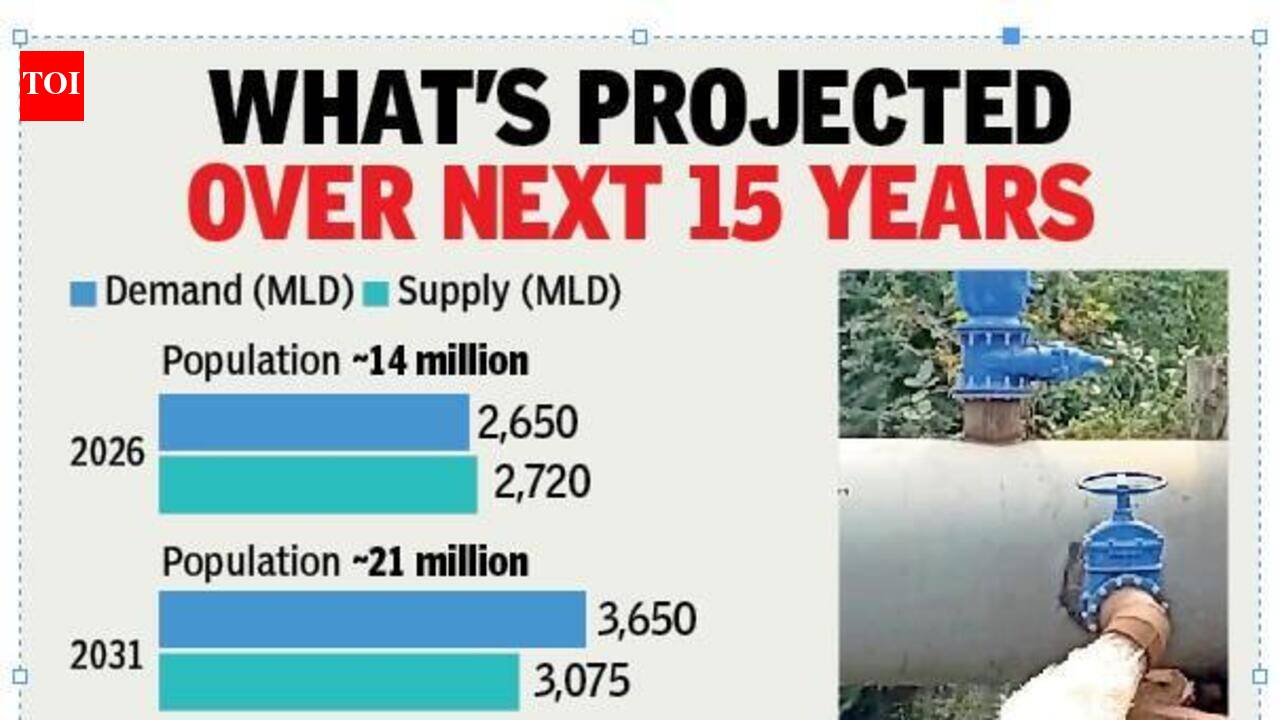
City demand is 2,650 MLD against supply of 2,720 MLD, including about 800 MLD from borewells. With population projected at around 21 million by 2031 and 28.3 million by 2041, the deficit is expected to reach 575 MLD and 1,670 MLD respectively.
Background
Bengaluru's water system relies on Cauvery water carried nearly 140 km and pumped about 450 metres, making it energy-intensive. Groundwater levels have fallen, and borewells supply about 800 MLD of the city's 2,720 MLD supply.
Why it matters
Residents of newly merged villages and peripheral layouts depend on BWSSB for piped water and sewerage networks, for which no coverage timeline has been given.
Sources
Reported from these outlets. The scale shows each outlet’s general leaning, from left to right.
- The Times of IndiaBWSSB jurisdiction rises by 2,196 sqkm as Bengaluru plans water expansion amid untreated sewage concernsLeaning: Centre-right